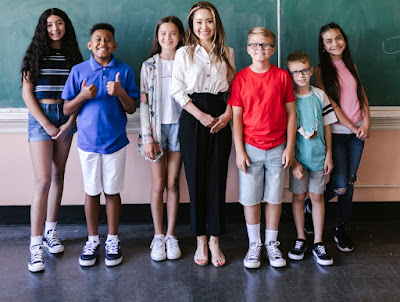
What Kindergarten Parents Should Do Before Kindergarten


Get the child to start developing a routine at home. Doing the same things at the same time during the day help the child to adapt to the routines of kindergarten. These activities can be getting up in the morning, dressing, bathing, meals, nap time, etc.

Start reading to your child. The earlier the better. Get them interested in words and pictures. This also preps them for instruction time in kindergarten. Give your child their own big picture and word books to look at whenever they want.

Play thinking games. Ask questions about their day, their pets, or when shopping. Ask them thinking questions, like, should we wear sandals or shoes today, and why. Get them involved in preparing a meal.

Coloring books and drawing time. Children should start using crayons and other appropriate things to color and draw. It's not about perfection or realism, it is about the skill of using a writing and color instruments. It also fosters creativity.

Start them on the road to being independent. Start dressing themselves. Put their toys away. Wash their hands. Of course they should be feeding themselves and picking up their own dishes. These are things they need to be doing when they start kindergarten.

And that of course means not turning to you for help each and every time. If they drop something, they pick it up. If they make a mess, they clean it up, or at least help. Hang up a coat, put boots away, etc. If something they can do needs to be done, they are encouraged to do it themselves. Perfection is not needed, but attempts are a must.

Give them chores and responsibilities. This could be picking up all dishes after eating. Sweeping a floor. Wiping off their own faces. Getting a tissue and using it for themselves. If you go on a picnic, have them carry something. Anything the family does, they have a part in.


Top Most Comfortable Shoes for Teachers


All feet are different, and you might go through several shoe brands before settling on one that suits you. We have compiled a list of the top five shoe brands that many teachers attest to.

Allbirds Shoes: They say they are like walking on air! Visit: Sustainable Shoes & Clothing | The Most Comfortable Shoes in The World | Allbirds

Sanuk Shoes: Teachers claim they are easy on the feet! Visit: Women's Sidewalk Surfers | Sanuk® Official

HOKA Shoes : A durable and very comfy shoe. Visit: Women's Recovery Sandals & Shoes | HOKA®

UGG (Not just for boots!) Visit: Women's Fashion Sneakers & Slip-Ons - Pay Later with Afterpay | UGG®

Hot Chocolate- Chocolaticas: Support, comfy, and oh so cute! Perfect for a teacher of younger children.  Visit: Women's Slip-Ons – Hot Chocolate Design


Where is the Best State to Work as a Teacher?


Wallethub has compiled a state by state ranking for places best to teach. So, if you thinking of relocating, this might be a start. The rankings take into account things like salary, pensions, tenure, turnover rate, and enrollment. The top 5 states were:

New York

Utah

Virgnia

Texas

Florida

Washington


The bottom 5 states/areas were:

New Mexico

Arizona

Wash. DC

New Hampshire

Hawaii


Remember, this is only a guide. Teachers are individuals and these states might not suit you. There are things like climate, commutes, and what you may or may not like as far as living conditions and attractions nearby. Many of these rankings are subjective.


To see the whole list, and where your state ranks, visit:

Wallet Hub's Teacher State Rankings: 2022's Best & Worst States for Teachers (wallethub.com)


Why schools should rethink cursive instruction in modern literacy programs


The students you encounter today probably will not know how to read cursive, let alone write with it. And they get by just fine. So, what happened, and are there any consequences of this?

If you go back to the history of writing, humans hand wrote for centuries. Then inventions like the printing press changed writing. No longer was all printed material hand written.

As time went on from there, other things came along. Like the typewriter. Soon type written correspondence and manuscripts became the norm. Teachers demanded students turn in perfect, typed essays and reports.

The implementation of computers in every walk of life ushered in the word processor. Those computers led to communicating more and more electronically. Email first, then the explosion of texting.

Cursive was now rapidly becoming an unneeded skill. The student of today has little need for cursive. No matter what your feeling on cursive is, that is the honest truth.

Over 10 years ago, updated standards, like Common Core, the cursive requirement was entirely eliminated. The cheer around the world from young kids learning cursive was deafening.

So, we now live in a world where people just do not do cursive, and have no need for it. 

If that makes sad or mad as a teacher, just think about things we no longer teach or use in modern classrooms. Latin, slide-rules, film projectors, record players, slate and chalkboards are just a few.

And let's be frank. Like it or not, writing throughout history has always an evolving technology.

Let's not kid ourselves and over-romanticize cursive. It really is a fading talent.

But now we get to the heart of this post. Like all fading "technologies" and skills, there are bound to be repurcussions.

First, how about signatures? We can't worry about much. Your signature was never about cursive, although that was common. So signatures today, for our young students, are some amalgamation of the letters they have learned to make.

But one of the biggest consequences is reading and interpreting old-style documents, manuscripts, and art work. Students who do not learn to write cursive, will most likely have a hard time reading it.

Showing a copy of, oh let's say The Declaration of Independence, becomes an excercise in futility. It's hard enough for a normal human to read the old-fashioned letters, but what about the modern student? They are now looking at that document as just an old piece of paper. They need a printed, typed out copy to get anything out of it.

It's a shame to admit it, but soon anyone working in a museum will probably be taking a night course on reading cursive. Similar to what a person needs if they are going to need to read Latin or some ancient writing.

The student of today needs to concentrate on modern skills, and keyboarding is at the top of the list. So please don't lament the loss of cursive instruction too long.

Those who go into history, or want to truly be a history buff, will need to learn to read and write cursive. Cursive skills won't die out completely, but sooner or later, people will not even be discussing it. It won't be there. Out of sight, out of mind.

Other things are going the way of the dinosaur as well. Some you probably never learned if you are part of a newer generation. Like dial phones. Film cameras.

You might not have even thought about shorthand, as you yourself may have never even seen it, let alone heard about it. That too has been almost eradicated by modern recording devices. Court reporters still use some shorthand machines, but they too will be phased out by artificial intelligence and digital recording devices.

As technology takes over tasks, it just creates a whole new skill set that students need. Don't lament the loss of cursive too long. And if you know how to read and write it, think of yourself as having a talent that can actually be valuable in many situations.

In the end, cursive writing no longer justifies the time it demands in today’s classrooms. With digital communication dominating how students read, write, and work, instructional minutes are better spent on skills that directly support modern literacy—clear typing, critical thinking, and effective communication across media. While cursive may hold nostalgic or historical value, it is no longer a practical necessity for academic success or adult life. Schools must make hard choices about priorities, and in a crowded curriculum, teaching cursive is a tradition that can be respectfully set aside in favor of skills students will actually use.

Someone, someday, might come up to you, hand you a letter from their great-grandfather, and ask, "Can you read this for me?"

Classroom Ice Breaker or Fun Brain Break: Line Up by Birthdays


Teachers can use this activity as an ice breaker to get to know the class, anytime as a brain break or fun activity. You could do this once a month to see how many students remember where they were.

This activity involves the whole class at the same time. It could get a little chaotic, so be prepared!

All the kids get together on side of the room. They may need to spread out to complete it.

They are going to line themselves up by birthday as to how it occurs during the year. (Not by years, obviously). That is, a student born on January 25 lines up before someone born on March 3. And so on. Lining up left to right is probably best.

To add a little fun, get yourself in the activity too!

You may choose one or two students to coordinate, one boy, one girl, for example. They must get in line too, where their birthdays fit.

When they think they are finished, you can choose another student to go down the line and write all birthdays down, as a final check. If they are off, they need to correct their places.

It won't take too long to write down. You should have a paper with the months in order, and keep track of the day. If you want to get more detailed, you can write the student's name down as well.

You can then describe the birthdays to the class, and involve them. For example, point out who was born earliest in the year, latest, etc. Which month had the most birthdays? Anyone born on a holiday? Get creative.

Have fun and good luck!

.

Brain Breaks: Some Great Ideas


 Brain breaks are to be used to break up the tedious tasks of learning. Brains get worked in different areas, and sometimes these areas need a break to reset and refresh. Brain breaks are short, movement involved, and may require a different (fun?) way of thinking.

The two brain breaks here not only involve movement, but stimulate in other ways as well. The second brain break below not only is a true brain break, but can also be incorporated to be a regular learning task as well. The best of both worlds!

Brain Break #1: Move Around

The goal here is to get the kids moving around, let off some energy. The class stands up and the teacher is the first to call out a movement. Let's say, "fish." When the teacher calls out fish, all students must start acting like a fish. After a few moments, the teacher calls the name of a student. That student then decides what to movement to call next. The class moves to that, and the teacher calls out another student's name. Repeat until your brain break is over. A variation of this is to let the students move around the room while doing the movements. It does not need to be an animal. It can be literally anything that moves, such as a clock, car, cloud, etc.

Brain Break #2: Which Would you Choose?

This one involves moving, so be prepared. Students all gather in the front of the classrom. The teacher asks a question with two choices. Such as, "Vanilla ice cream or chocolate." The students run/walk to the sides of the room that go with their choice. Tell them left for vanilla, right for chocolate. Have the students count how many are in each group, write the results on the board. Gather the students at the front of the room, and repeat the whole thing again with another choice question. Make up a bunch so you never need to ask the same thing twice. Do this as many times as you wish. Afterward, you could have all students maintain a journal and keep track of the results. They could make bar graphs, etc.

Want more? Try The Line up by Birthdays Game 


1 in 10 teachers say they’ve been attacked by students

How Many Teachers are Attacked each Year?

📊 What we know from national data

• Overall prevalence: thousands of teachers every year

  • According to the National Center for Education Statistics (NCES), during the 2020–21 school year about 4 % of public‑school teachers reported being physically attacked by a student, and 6 % reported being threatened with injury. National Center for Education Statistics+2National Center for Education Statistics+2

  • That translates to roughly 155,000 public‑school teachers physically attacked in that single school year. IJR+1

  • Elementary school teachers — especially in pre-K through 6th grade — reported higher rates: in 2020–21, about 7 % of elementary teachers said they were physically attacked, compared with about 1 % of secondary teachers. National Center for Education Statistics+1

• Threats and violence more common than widely assumed

• Beyond physical attacks: a broader pattern of victimization

  • According to a large survey over multiple years, only 17 % of teachers reported no victimization. The most common types were verbal abuse (about 45 %) and non‑physical aggression (29–35 %). National Institute of Justice

  • Physical assaults were less common, but still significant. In one wave, 7 % of teachers (70 out of 1,044) reported being physically assaulted. National Institute of Justice


⚠️ Why the real number is likely higher — and why we don’t have a perfect count

Underreporting — many teachers don’t speak up

  • In one survey of 2,505 K–12 teachers who experienced violence, 24 % didn’t tell their family, and 14 % didn’t tell colleagues. Only 12 % got counseling. Education Week+1

  • Some teachers may fear stigma, retaliation, or believe “it comes with the job,” especially for less severe but chronic violence (shoving, verbal threats, harassment). Christian Science Monitor+1

  • Because of that, official statistics — which rely on self-reporting or formal incidents — almost certainly miss many cases.

Broad range of “attacks” — from verbal abuse to serious physical violence

Variation across school type, grade level, and reporting methods

  • Elementary teachers report higher victimization rates than secondary teachers. National Center for Education Statistics+1

  • Different studies use different definitions — “physically attacked,” “threatened,” “harassed,” “victimized” — making comparisons tricky.

  • Some data come from formal incident reports; others from voluntary surveys. The latter often reveal higher rates, suggesting formal reports undercount incidents. Education Week+2National Center for Education Statistics+2


🎯 What the numbers mean — and what they don’t

  • Significant but often hidden problem. Even conservative estimates (4–6 % physically attacked in a year) mean tens or hundreds of thousands of teachers nationwide are impacted annually.

  • Psychological toll. Many teachers endure repeated non‑physical abuse — verbal harassment, intimidation, threats — which may never qualify as “assault,” but still take a serious psychological and professional toll.

  • Limits of data — undercount likely. Because of underreporting, stigma, and inconsistent definitions, the real rate of teacher victimization (physical or not) may be substantially higher.

  • Unequal risk. Elementary teachers, special‑education staff, and those in certain urban or high‑needs schools appear more vulnerable.


🔎 What researchers recommend — better tracking and prevention

Because of these reporting and definition issues, experts recommend:

  • Creating a national registry for violence and harassment against school staff to standardize reporting. Christian Science Monitor+1

  • Offering support and counseling for victimized teachers — too often, victims don’t share their experiences or receive help. Education Week+1

  • Investing in behavioral supports, classroom‑management training, and school climate improvement, especially in higher‑risk environments. Education Week+2National Institute of Justice+2


✅ Conclusion — It’s more common than many assume

The data show that a substantial number of teachers are physically attacked or threatened every year — and many more endure non‑physical abuse. Given underreporting and inconsistent tracking, the true scope of teacher victimization is likely larger than the official numbers indicate. For schools, policymakers, and communities, this underscores the need for better data, more support for educators, and efforts to improve school safety and climate.